


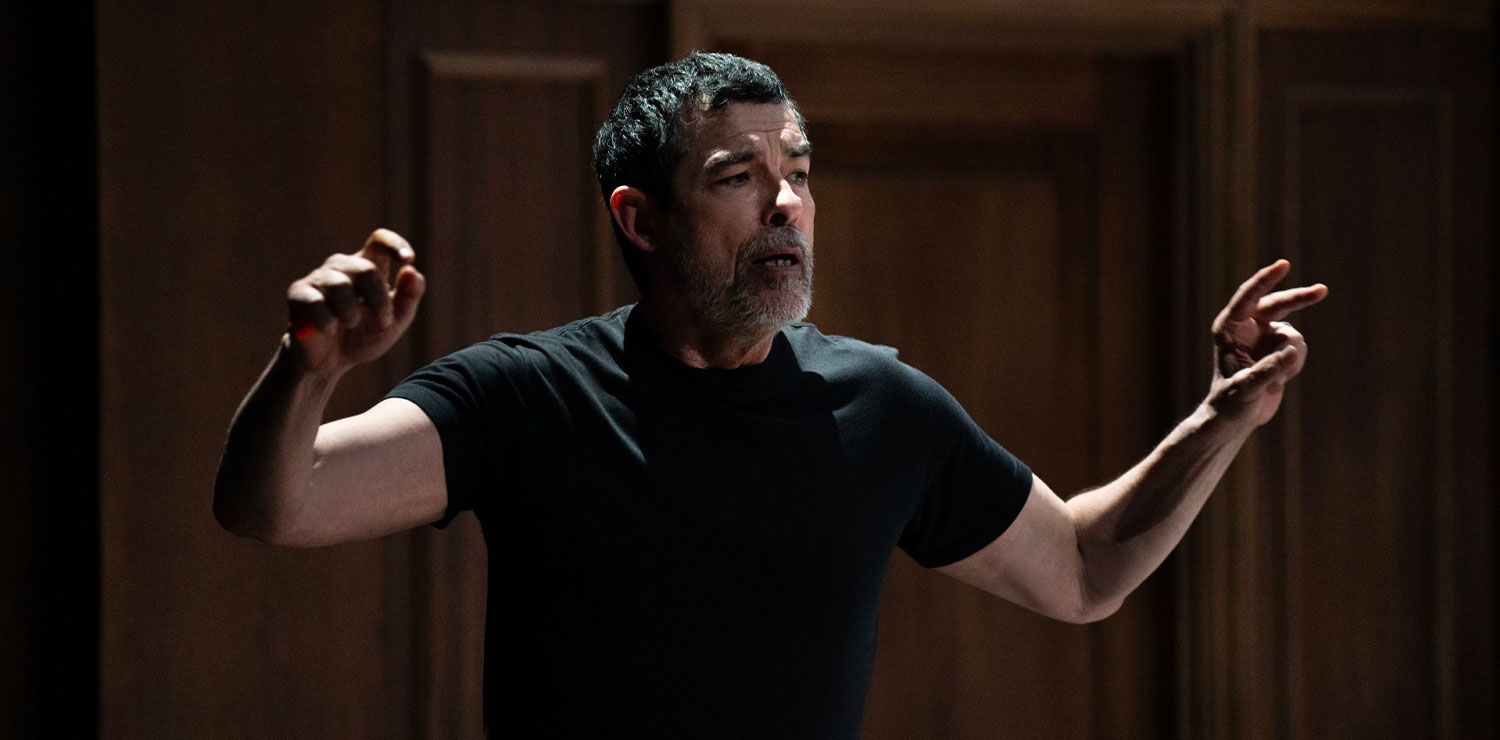


Teatro della Pergola in Florence: the 2026/2027 performance schedule
All the shows and concerts you shouldn't miss
The new 2026/2027 season at Florence’s Teatro della Pergola, titled “In Alt(r)o Mare” and directed by Stefano Massini, features a rich lineup of major stars from the national and international theater scenes.
The Rattling Cap
November 3–8
In this revival of Luigi Pirandello’s two-act comedy, Silvio Orlando takes on the role of Ciampa, masterfully portraying the character’s profound and tragic humanity without sacrificing an ambiguous and ironic sense of humor. (by Luigi Pirandello, directed by Andrea Baracco)
Oscar
November 10–15
Sonia Bergamasco plays Oscar, a young woman raised as a man according to her father’s wishes so that she could follow in his military career. Based on the play by Linda Dalisi, this drama explores the themes of sacrifice, loyalty, and justice that accompany the young woman on her journey to discover her identity and in a profound exploration of her inner self. (by Linda Dalisi, directed by Antonio Latella)
Cinema Cielo
November 17
In this production, dialogue drawn from Jean Genet’s novel Notre Dame des Fleurs is set against the backdrop of the historic adult movie theater Cinema Cielo—which closed permanently in 1997—exploring the loneliness and torments of the characters who inhabit it. (by Danio Manfredini, directed by Danio Manfredini)
Fire Was the Cure
November 21–22
The plot of Ray Bradbury’s renowned novel Fahrenheit 451 is reimagined and enriched with reflections, digressions, and parallel narrative threads, becoming a point of reflection on the future and the value of culture. (loosely based on Ray Bradbury’s Fahrenheit 451, created by Sotterraneo)
The Tsar
November 24–December 6
Drawing on the official biography and a wealth of external sources that have provided a broader perspective, Stefano Massini offers an unfiltered account of the path that led Vladimir Putin to the pinnacle of power, tracing his journey from a young age. The result is a raw and authentic monologue that retraces the most significant stages of his life. (written and performed by Stefano Massini)
The Last Moons
December 8–13
This production of Furio Bordon’s famous play (1992) addresses the themes of old age and death through profound and intimate language, evoking memories of the past and lucidly analyzing the fragility of life and the role of family ties. (by Furio Bordon, directed by Paolo Valerio)
Scent of Hell
December 15
An incredible journey into the brilliant and twisted mind of one of the greatest artists and composers, thanks to Piero Pelù’s performance. (from the diaries of Kurt Cobain)
Ritorno a casa Gori
December 29 – January 8
This is the second installment of the Gori Trilogy, conceived by Alessandro Benvenuti and Ugo Chiti. In this family saga, Benvenuti is the sole performer on stage, giving voice to all the characters and lending the right tone to the stories. The action unfolds around a wake, against the backdrop of which the vulnerabilities and secrets of a middle-class Tuscan family are laid bare. (by Alessandro Benvenuti, Ugo Chiti)
Orlando Furioso
January 12–17
A contemporary interpretation of Ludovico Ariosto’s famous chivalric poem, driven by female characters who take center stage in stories where love, passion, and power highlight human complexity. (by Ludovico Ariosto, directed by Davide Livermore)
From Mother to Daughter
January 19–21
A theatrical adaptation of the novel of the same name, in which three seemingly distant generations are closely bound by a single thread and share the same sense of oppression imposed by society. Through family stories and memories, Concita De Gregorio plays herself and Marilù, and explores the nature of bonds—the result of invisible legacies passed down from generation to generation. (written and performed by Concita De Gregorio, directed by Gaia Saitta)
Incendi
January 22–24
A contemporary tragedy that, following the structure of *Oedipus*, centers on Nawal, a woman grappling with her own destiny. In a time where past and present coexist, we wonder if it is possible to break the chain of hatred and violence, while Nawal embarks on a journey through memory and history, so that the ashes concealing the facts and collective pain may be stirred up. (by Wajdi Mouawad, directed by Marco Lorenzi)
One of the final nights of Carnival
January 26–31
A three-act comedy by Carlo Goldoni (1761) that serves as the author’s farewell to the Venetian audience. The play celebrates the essence of theater and explores the human soul from a modern perspective, thereby creating a direct dialogue with the audience, who can recognize themselves in the characters and their interpersonal dynamics. (by Carlo Goldoni, directed by Valerio Binasco)
Franciscus. The Madman Who Spoke to the Birds
February 2–7
A production by Simone Cristicchi celebrating the figure of St. Francis of Assisi, shedding light on his journey—one not without doubts and difficulties. Through reflections and questions, the production seeks to reconstruct his quest for spirituality and what makes his message relevant even today. (written with Simona Orlando)
Blank Ballot
February 9–14
A reflection on democratic societies inspired by José Saramago’s Seeing, from which the script by Emanuele Aldrovandi and Serena Sinigaglia was adapted. On the day of the municipal elections in the capital of a democratic state, the citizens cast blank ballots. The commissioner, played by Rocco Papaleo, will lead the investigation following a full-scale state of emergency declared by the president. (Based on the novel *Seeing* by José Saramago, directed by Serena Sinigaglia)
Cain’s Self-Defense
February 16–21
A monologue written by Andrea Camilleri one year after his death in 2019. It is a testament—the final words that Andrea felt a deep desire and urgency to share with his audience—making this a performance you simply cannot miss. (by Andrea Camilleri, starring Luca Zingaretti, directed by Luca Zingaretti)
Prayer. Times of War
February 23–24
A story told through dance, an act of prayer and rebellion against war expressed through the body. Through choreography, accompanied by readings and an analysis of photographs by Paolo Pellegrin, the piece reflects on injustice and celebrates life. (by Virgilio Sieni)
Fotofinish
February 27–28
The performance tells the story of a man whose loneliness is so overwhelming that it drives him to create new personas through photography, to the point where he loses his own identity. The illusion of living many lives severs his connection to reality, obscuring the only true “presence” of life: loneliness. (by Flavia Mastrella and Antonio Rezza, with Antonio Rezza and Manolo Muoio)
The State vs. Nolan (A Quiet Place)
March 2–7
The story of the trial of Herbert Nolan, editor of a local newspaper and shareholder in an arms manufacturer, suspected of manipulating information to increase the profits of a local arms manufacturer.By Stefano Massini. (A play by Alessandro Gassmann, starring Daniele Russo)
Fifth: Thou Shalt Not Kill
March 9–10
Inspired by Ernst Lubitsch’s film Broken Lullaby, this play explores the themes of forgiveness and the need to find peace. A few years after World War I, a former French soldier is still tormented by having killed a German soldier and will do everything in his power to seek absolution for the murder. (a play by Massimiliano Civica)
The Madness of King George
March 12–21
A drama that, through an exploration of the figure of King George III, reflects on the vulnerability of a figure of authority in the face of illness, and on the attitude of those around him, torn between opportunism and loyalty. (by Alan Bennett, directed by Massimo Popolizio)
Man Is Poetry
March 22
Poetry is the essence of being, where the word is a living organism expressed by the author through body and voice. In this tribute to Orazio Costa, Gabriele Lavia will take on this poetic mission. (from the diaries of Orazio Costa)
A Place of Safety: A Journey Through the Central Mediterranean
March 24–25
The theater stage meets the investigations and testimonies of those who have provided aid in the Mediterranean Sea along the migration route. The driving force behind this exploration is the desire to understand the motivations that compel people to set sail despite their fear, and the ways in which Europe could actually be of help. (conceived by Kepler-452)
The Bacchae
April 2–4
In this version of Euripides’ tragedy, Dionysus is reimagined as a symbol of theatrical art but, above all, as the archetype of the refugee. Theodoros Terzopoulos, the Greek master directing the production, emphasizes how important it is, in an era like ours, to move beyond individualism and create a new future together. (directed by Theodoros Terzopoulos)
Hamlet
April 6–11
Leonardo Lidi’s production of the quintessential tragedy, in which today’s audience can always recognize themselves thanks to the timeless relevance of the theme and the psychological complexity of the characters. (by William Shakespeare, directed by Leonardo Lidi)
The Two Venetian Twins
April 13–18
Carlo Goldoni’s comedy, written in 1747, features two twin brothers, both played by Tullio Solenghi, whose debut was marked by the play of the same name in 1971. This production pays homage to the 1963 staging by the Teatro Stabile di Genova and features the collaboration of Davide Livermore. (by Carlo Goldoni, directed by Tullio Solenghi)
Extra moenia
May 12–13
The story of a seemingly ordinary day in the lives of characters leading different lives, yet one that perfectly captures society and the atrocities of our present. Despite the absence of a true plot, the stories prompt reflection on how essential it is to peel back the veil of indifference that hides reality from our eyes. The only way out of passive acceptance is through sharing a collective ritual—the journey in the same direction. (by Emma Dante)
The 2026/2027 Concert Season of the Amici della Musica di Firenze
The season kicks off on October 31 with violinist Viktoria Mullova and pianist Alasdair Beatson, performing a program dedicated to Beethoven. On November 7, pianist Lucas Debargue takes the stage with works by Rachmaninoff, Debargue, and Mussorgsky, followed on November 14 by Paul Lewis, performing works by Mozart, Schubert, and Chopin. On November 28, Lukas Sternath will perform a repertoire dedicated to Schubert and Liszt, while on November 29, the Cello Ensemble and the Indaco Quartet will pay tribute to Italian cellist Franco Rossi on the 20th anniversary of his passing.The program continues on December 5 with Arsenii Moon, winner of the Ferruccio Busoni International Piano Competition, who will perform works by Scriabin, Scarlatti, Chopin, and Ravel. On December 12, pianist Jean-Efflam Bavouzet takes the stage with works by Haydn and Debussy. After the Christmas break, on January 16, the King’s Singers return with Food, Glorious Food, an original musical journey through the cuisines of the world. On January 23, cellist Ettore Pagano and pianist Maximilian Kromer present a program dedicated to Beethoven, Schubert, and Hummel, while on January 30, the spotlight is on La Lira di Orfeo, a Baroque ensemble founded by countertenor Raffaele Pe.On February 6, pianist Pietro De Maria tackles the great piano repertoire, followed on February 13 by Elisso Virsaladze, a Beethoven specialist. On February 20, Paul Lewis returns to the Pergola with music by Mozart, Mendelssohn, and Copland. On March 6, the trio consisting of Veronika Eberle on violin, Julia Hagen on cello, and Herbert Schuch on piano will present an evening dedicated to Schubert and Beethoven. On March 13, cellist Steven Isserlis and pianist Connie Shih will perform works by Beethoven and Schumann, while on March 20, the Quatuor Psophos will accompany soprano Sandrine Piau in a program dedicated to Schubert.The season continues on April 10 with Vox Luminis, conducted by Lionel Meunier, performing Giovanni Pierluigi da Palestrina’s famous Missa Papae Marcelli. Rounding out the program on April 17 are soprano and conductor Barbara Hannigan and pianist Bertrand Chamayou, who will headline a concert dedicated to Messiaen, Scriabin, and Zorn.


