


The unmissable works of the Uffizi Gallery
The must-see masterpieces for an incredible visit inside the world's most famous museum
A list of timeless beauty that tells the story of art not through words but through images of great balance and charm. Ten masterpieces, ten artists: each one is worth a visit to the Uffizi Galleries, one of the museums we highly recommend you see in Florence, an inexhaustible treasure trove of beauty.
A word of advice: take your time and savor each work in the recently renovated exhibits. They will transport you to fantastic worlds... But that's not all. If you prefer a more in-depth guide, don't miss our wonderful itinerary!
Cimabue, Maestà di Santa Trinita, 1280-1290. Room 2
Originating from the Vallombrosan church of Santa Trinita in Florence, the painting has been attributed since the 16th century to Cimabue, the most important Florentine painter of the 13th century. Seated on a large ivory throne, imposing and articulated like a piece of architecture, the Virgin points with her right hand to the Child she is holding in her arms, according to the Byzantine model of the Odigitria, meaning ‘she who shows the way to salvation’.
The Baby Jesus, dressed like an ancient philosopher, blesses and clutches a rolled-up parchment, perhaps the scroll of the Law. The garments of Mary and her Son are characterized by precious golden decoration, agemina, characteristic of the Byzantine pictorial tradition. Around the Marian group, eight angels with splendid colorful wings delicately support the throne. Rather unusual is the depiction, below the throne, of some Old Testament prophets (from left: Jeremiah, Abraham, David, and Isaiah) holding phylacteries with passages from the Holy Scriptures alluding to the mysteries of the Incarnation and the Virginity of Mary.
 Maestà di Santa Trinita, Cimabue
Piero della Francesca, Dittico dei Duchi di Urbino, 1465-1472 circa. Room 8
One of the most famous portraits of the Italian Renaissance, this diptych depicts the lords of Urbino, Federico da Montefeltro (1422-1482) and his wife Battista Sforza (1446-1472). In accordance with 15th-century tradition, inspired by ancient numismatics, the two figures are depicted in profile, immune to turmoil and emotion. The spatial unity shared by the couple is suggested by the light and the continuity of the hilly landscape in the background—the Marche region over which the Montefeltro family ruled.
The chromatic contrast between Federico's tanned complexion and Battista Sforza's very pale skin is striking. This pallor, in addition to respecting the aesthetic conventions in vogue during the Renaissance, could allude to the early death of the duchess, who died very young in 1472. On the back of the panels, the dukes are depicted being carried in triumph on carts, accompanied by the Christian virtues; the Latin inscriptions praise the moral values of the couple. One of Piero della Francesca's most famous works, the double portrait is part of the established relationship between the painter and the Dukes of Montefeltro, at whose court Piero stayed repeatedly. The master combines the rigorous perspective he learned during his training in Florence with the representation of nature typical of Flemish painting.
 Doppio ritratto dei duchi di Urbino, Piero della Francesca
Sandro Botticelli, Primavera e Nascita di Venere. Room 10-14
There are two Botticelli masterpieces in the Uffizi Gallery that enchant visitors from all over the world. Let's start with an interesting fact: both paintings feature Simonetta Cattaneo Vespucci, a Genoese noblewoman loved by Giuliano de' Medici, the younger brother of Lorenzo the Magnificent, and idolized by Sandro Botticelli, who made her his muse, immortalizing her in his most famous paintings. We find her, in fact, in the guise of the goddess Venus in The Birth of Venus and as one of the Three Graces (the one in the center) in the allegory of Spring. She was also the muse of numerous other artists, among whom Piero di Cosimo stood out, painting the Portrait of Simonetta Vespucci, in which she is depicted as Queen Cleopatra, with an asp around her neck.
 Primavera, Sandro Botticelli
Turning to the works, both of which are large in size, the first, known as Primavera, depicts nine figures from classical mythology walking across a flower-filled meadow in front of a grove of orange and laurel trees. In the foreground on the right, Zephyr embraces and impregnates the nymph Chloris, depicted a little further on in the guise of Flora, goddess of flowering. Dominating the center of the composition, slightly set back, are Venus, the goddess of love and beauty, chastely dressed, and Cupid, depicted blindfolded as he shoots his arrow of love. On the left, the three Graces, minor beneficent deities close to Venus, dance in a circle, and the composition is completed by Mercury, the messenger of the gods, wearing a helmet and winged sandals, who touches a cloud with his caduceus. The work celebrates love, peace, and prosperity. The vegetation, whose dark color is partly due to the alteration of the original pigment, is brightened by an abundance of flowers and fruits. As many as 138 different plant species have been identified, carefully described by Botticelli, perhaps with the aid of herbariums. The attention to detail confirms the master's commitment to this work, which is also confirmed by the technical skill with which the painting was executed. Painted on a poplar wood support, at the end of the 15th century the work was located in the house on Via Larga (now Via Cavour) belonging to the heirs of Lorenzo di Pierfrancesco de' Medici, cousin of Lorenzo the Magnificent. It hung above a small bed, or rather a sort of chest with a backrest, characteristic of the furnishings of Renaissance stately homes.
It then moved to the villa in Castello, where Giorgio Vasari described it in 1550 together with The Birth of Venus. This second masterpiece by Botticelli depicts more precisely the arrival on the island of Cyprus of the goddess of love and beauty, born from the sea foam and carried by the winds Zephyr and, perhaps, Aura. The goddess stands on the shell of a conch, pure and perfect as a pearl. She is welcomed by a young woman, sometimes identified as one of the Graces or the Spring Hour, who offers her a cloak strewn with flowers; the roses carried by the winds also refer to the spring season. The theme of the painting, which celebrates Venus as a symbol of love and beauty, was perhaps suggested by the poet Agnolo Poliziano. Unlike Primavera, which was painted on wood, The Birth of Venus was painted on canvas, a medium often used in the fifteenth century for decorative paintings intended for stately homes.
Battesimo del Cristo - Andrea del Verrocchio (Firenze 1435- Venezia 1488) Leonardo da Vinci (Vinci 1452 – Amboise 1519). Room 35
The events depicted in the painting: on the banks of the Jordan River in Palestine, Jesus receives the sacrament of baptism from Saint John, who wipes his head by pouring water on it. The Baptist holds a slender cross and a scroll inscribed with the announcement of the coming of the Savior: ecce agnus dei [qui tollit peccata mundi] (Behold the Lamb of God who takes away the sins of the world; Gospel of John 1:29). Two kneeling angels witness the event, one of whom holds Jesus' robe. In the mid-16th century, Giorgio Vasari recounted that Andrea del Verrocchio enlisted the help of his young pupil Leonardo to execute the painting. Leonardo painted the figure of the angel on the left with such extraordinary skill that it annoyed Verrocchio. It is said that, as a result of this collaboration, Leonardo's master stopped painting and devoted himself solely to sculpture.
 Battesimo del Cristo, Andrea del Verrocchio, Leonardo da Vinci
Current studies tend to believe that Leonardo's involvement was more extensive and that he also contributed to the execution of the evocative river landscape, bathed in golden light, and the figure of Christ. It was common practice in 15th-century art workshops for the master to conceive the work and then leave the execution of secondary parts to his pupils and collaborators. It is likely that, in addition to Verrocchio and Leonardo, another older painter also worked on the panel depicting the Baptism of Christ, as suggested by the less evolved nature of certain details, such as the hands of God the Father and the dove of the Holy Spirit at the top. Leonardo's angel, on the other hand, stands out for the articulated pose of the body and the extraordinary naturalness of the drapery of the blue cloak.
Leonardo Da Vinci, Adorazione dei Magi (1481-1482). Room 35
A document dated July 1481 attests that Leonardo da Vinci undertook to complete the altarpiece for the high altar of the church of San Donato in Scopeto within 30 months. The painting had as its theme the Adoration of the Magi, that is, the celebration of the feast of the Epiphany in which, according to St. Augustine, all peoples respond to Christ's call. For this theme, Leonardo studied a very complex composition, rich in figures, arranged in a semicircle with the Virgin and Child at its center. Kneeling in front are the Magi, who bring gifts of gold, frankincense, and myrrh to Jesus. Leonardo paints a backdrop in which ruined architecture and clashes between horses and knights alternate; on the left is the construction of a building, perhaps a temple, preceded by two flights of stairs like the presbytery of some medieval churches (for example, San Miniato al Monte in Florence). The temple, which alludes to peace, contrasts with the crowd of knights in battle depicted on the opposite side.
 Adorazione dei Magi, Leonardo da Vinci
In September 1481, Leonardo was still working on the painting, but a few months later, the painter left Florence for Milan, to the court of Ludovico il Moro, interrupting work on the painting for the church of San Donato in Scopeto. The Augustinians waited in vain for the painter to return to complete the painting, until they decided to entrust the execution of a new altarpiece to Filippo Lippi, which was completed in 1496. Leonardo's Adoration of the Magi is therefore a painting suspended in its execution at a preliminary sketch stage. The master took the work through different stages of development: some figures are barely sketched, as if to capture an idea, while others are more refined. The sky is painted with a mixture of lead white and lapis lazuli.
Michelangelo Buonarroti, Tondo Doni, 1506-1508 circa. Room 41
Michelangelo painted this Holy Family for the wedding of Agnolo Doni and Maddalena Strozzi. Leonardo, Michelangelo, and Raphael were all in the city at the same time during those years. These were years of intense cultural fervor, and Agnolo was able to celebrate his noble wedding and the birth of his firstborn daughter with some of the greatest expressions of this exceptional flowering: portraits of the couple painted by Raphael and Michelangelo's tondo, which is the only painting by the master that is certain to be on wood. Michelangelo had recently studied the potential of the circular format, much appreciated in the early Renaissance for domestic devotional furnishings, in the marbles of the Tondo Pitti (Bargello National Museum) and the Tondo Taddei (Royal Academy in London): in both cases, the Madonna, Child, and St. John dominate the entire surface of the relief.
 Tondo Doni, Michelangelo Buonarroti
The Doni Tondo is also conceived as a sculpture, in which the pyramidal composition of the group dominates almost the entire height and width of the panel. It is a compact group reminiscent of the structure of a dome, animated within by the twisting of the bodies and the chain of gestures accompanying the delicate passage of the Child from the hands of St. Joseph to those of the Virgin. This highly articulated and expressive composition stems from Michelangelo's knowledge and study of the great marbles of the Hellenistic period (3rd-1st century BC), characterized by serpentine movements and strong expressiveness, which were emerging from the excavations of Roman villas. Some of these important finds, such as the Apollo Belvedere and the Laocoon excavated in January 1506, are accurately referenced in the painting among the figures of naked people standing leaning on a balustrade (to the left and right of St. Joseph, respectively). The presence of Laocoon allows us to date the tondo to coincide with the birth of Maria Doni (September 1507).
The naked youths, whose identification is complex, seem to represent pagan humanity, separated from the Holy Family by a low wall representing original sin, beyond which there is also Saint John, which would favor a baptismal interpretation of the painting. The frame of the tondo, probably designed by Michelangelo, was carved by Francesco del Tasso, a master of the finest Florentine woodcarving tradition.
Raffaello Sanzio, Madonna del cardellino, 1506 circa. Room 41
The painting was created during Raphael's stay in Florence (1504-1508). In his biography of the painter, Giorgio Vasari reports that this painting was commissioned for the wedding of Lorenzo Nasi and Sandra di Matteo Canigiani, celebrated on February 23, 1506. When the Nasi house was swept away by a landslide in 1547, the panel shattered into seventeen fragments, which were collected and probably entrusted to Michele di Ridolfo del Ghirlandaio for restoration.
During his years in Florence, Raphael studied the great masters of the tradition. Through his study of the proportional laws of nature and the works of Perugino, Fra' Bartolomeo, and Leonardo, Raphael succeeded in creating images of ideal beauty, harmonious and perfect in their simplicity, but also vital and dynamic thanks to the intense exchange of glances and gestures that link the figures and the graceful variety of expressions, made more natural by Leonardo's sfumato technique, also used to dissolve the landscape on the horizon into the atmosphere. However, this modern image still contains symbolic elements of devotional tradition, such as the small sacred text held by the Virgin, a sign of her faith and a foreshadowing of Christ's sacrifice.
 Madonna del cardellino, Raffaello Sanzio
Torso Gaddi, artista ellenistico, II secolo a.C. Verone
The sturdy torso was purchased in 1778 by Grand Duke Pietro Leopoldo from the Gaddi collection in Florence; nothing is known about the work prior to this date, except for its presence in the aforementioned private collection. Derived from a 2nd-century BC prototype, the statue, of which only the torso remains, originally depicted a centaur with his hands tied behind his back. It belonged to a group consisting of a young, free, and exuberant centaur and an elderly one ridden by a cherub who struck him with a whip. What remains of the torso tells us of a youthful and muscular body, whose energy seems to be constrained by the limitations of the material with which it was made; the effort in the twist is palpable, made evident by the modeling. We can safely interpret it as a metaphor for the invincible power of Eros, capable of taming even the wild Centaurs. A symbol of strength and power, it was used repeatedly as a model for various art forms, including painting, especially in the period between the 16th and 17th centuries. A vivid example of this is the refined oil on panel entitled ‘Adoration of the Shepherds’ by Amico Aspertini, dated 1515 and preserved in the Uffizi (Inv. 1890 no. 3803). In the painting, the torso is depicted on the left side, resting on a marble base, very similar to an altar. An interesting fact: unlike other sculptures, this work was never completed to restore its original appearance. It was considered such a high-quality work of art and so powerful in provoking emotions that it was decided not to interfere with its extraordinary evocative power of the past.
 Artista ellenistico, Torso Gaddi
Michelangelo Merisi da Caravaggio, Testa di Medusa, 1597 ca. Caravaggio and 17th-century rooms
Caravaggio's Medusa shield is not a real shield, as the work was commissioned by Cardinal del Monte (Caravaggio's protector and great patron) as a gift for the Grand Duke of Tuscany, Ferdinando I de' Medici, in 1598. There was a political connection between the two, as the Cardinal was the Grand Duke's ambassador to Rome and went to enrich the Grand Duke's collection of weapons. In all likelihood, the subject of Medusa was particularly loved by the Grand Duke, as in the early 16th century, a Medusa painted by Leonardo was reported to be in his collection.
Caravaggio's Medusa remained in the weapons collection of the Grand Duke of Tuscany, Ferdinando I de' Medici, until the 18th century, when the entire contents of the armory were sold except for this work. Caravaggio's Medusa is the narration of an episode from classical mythology and depicts one of the three Gorgon sisters, Medusa, whose head was cut off by Perseus before her gaze could turn him to stone. Like all heroes, Perseus was cunning and used a shield as a mirror so that Medusa would be paralyzed by her own reflection. Caravaggio painted this masterpiece on a shield, and the image we see is that of Medusa as she meets his gaze, allowing Perseus to deliver the final blow.
 Testa di Medusa, Michelangelo Merisi da Caravaggio
The lesser-known masterpieces
Once you have seen the great masterpieces, your journey can continue in search of other works that are less famous but no less surprising. A journey that takes you from the great Renaissance altarpieces to the 17th-century rooms, ending with portraits and Nordic works that seem incredibly modern.
Battaglia di San Romano di Paolo Uccello. Room 7
Among the works not to be missed is a painting that has an almost cinematic energy. It is a work that immediately captivates you: horses in motion, weapons, geometric perspectives, broken spears as if they were decorative elements. It is not just a war scene, it is a true demonstration of style, a Renaissance that experiments and plays with vision.
Madonna col Bambino e due angeli. Room 8
A few steps away, the atmosphere changes completely with the sweetness of Filippo Lippi and his ‘Lippina’. Here everything becomes more intimate and human: the gazes are tender, the expressions delicate, and above all, those two little angels look like real children, with a disarming naturalness. It is one of those paintings that makes you stop without realizing it, because it communicates a rare calm.
 Madonna and Child with Two Angels, filippo lippi
Trittico degli Uffizi. Room 8.
Also in Room 8, Andrea Mantegna offers a sharp change of tone: while Lippi envelops you, Mantegna puts you on alert. The composition is rigorous, the colors intense, and the figures seem sculpted rather than painted. It is a perfect work for those who love painting that seeks not grace but impact and solemnity.
Ritratto di Eleonora di Toledo con il figlio Giovanni di Bronzino. Room 18
At this point, for those who love the more glamorous Renaissance linked to the court, the perfect work is the famous Portrait of Eleonora di Toledo with her son Giovanni by Bronzino (Room 18). It is impossible not to be struck by the dress: it is so rich and painted with such precision that it looks like real fabric. But beyond its aesthetic beauty, this painting is also a statement of power: Eleonora is not just a woman portrayed, she is a symbol of Medici Florence, elegant and untouchable.
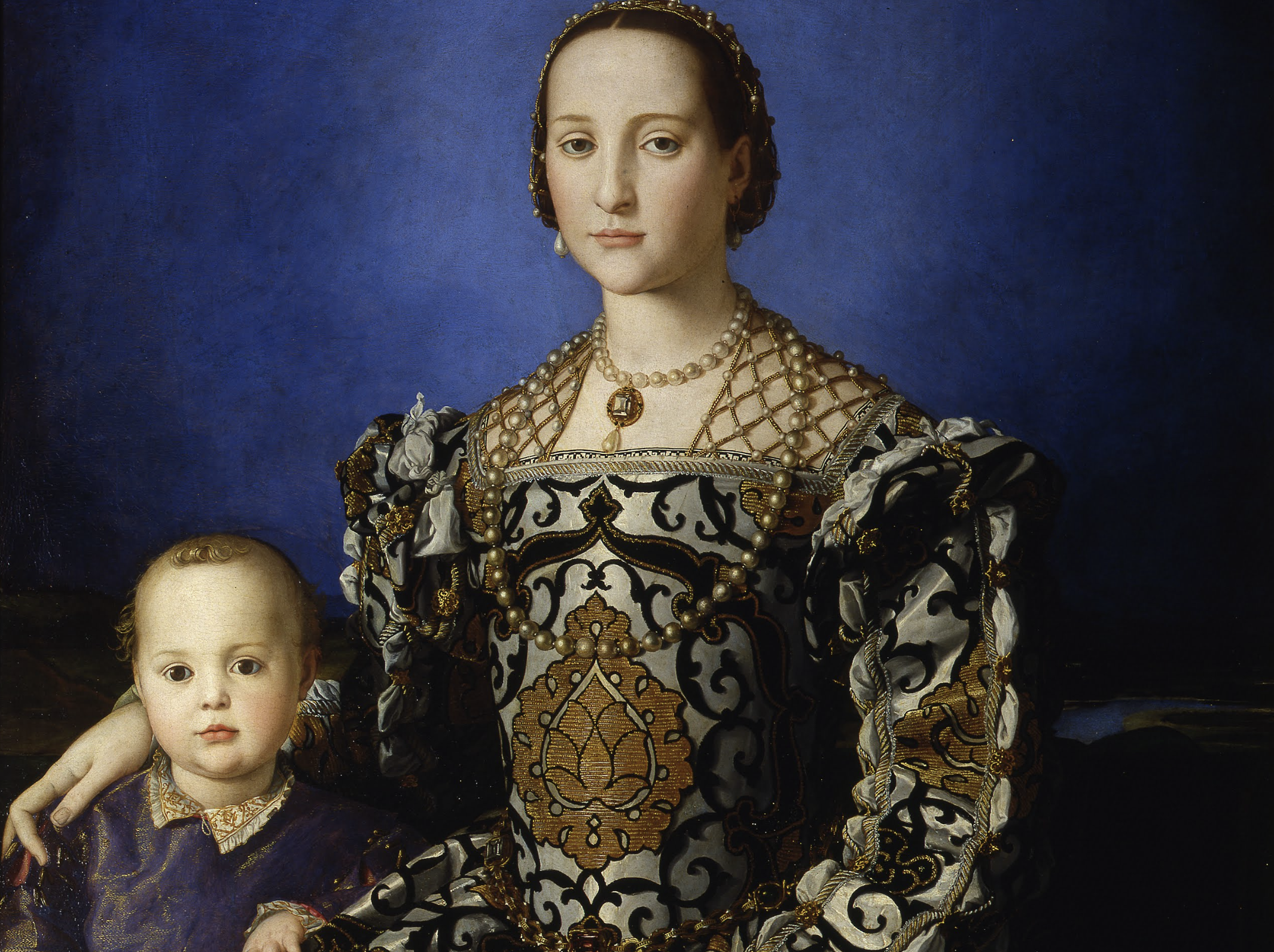 Il ritratto di Eleonora di Toledo del Bronzino
Madonna del latte di Correggio. Room 25
And finally, after so much grandeur, there is a work that brings everything back to a more intimate and human tone: a painting by Correggio that does not seek to impress with its spectacular nature, but wins you over with the delicacy of its light and a sense of natural, almost everyday motherhood. It is a perfect ending, because it reminds you that the Uffizi is not only about art history, but also the history of emotions.
La Venere di Urbino. Room 83
Then comes another turning point, because with Titian, art becomes pure seduction, a masterpiece that manages to be elegant and sensual at the same time, without ever falling into the banal. The protagonist's gaze is direct, conscious, and very modern. It is one of those paintings that you cannot just “look at”: it forces you to recognize how well the Renaissance knew how to portray desire with absolute refinement.
 In the center the Venus of Urbino of Titian
Giuditta che decapita Oloferne. Room 90
But if you are looking for a work that will strike you in the gut, the 17th-century room is a must-see. Here you will find Artemisia Gentileschi, with her powerful Judith. It is a painting that seems like a scene frozen in its most dramatic moment: blood, tension, bodies fighting. Artemisia paints Judith not as a fragile heroine, but as a determined woman, the absolute protagonist of the action. It is one of those images that are not easily forgotten.
 Artemisia Gentileschi, Giuditta con la sua ancella
Bacco. Room 90
And right there, in the same room, Caravaggio awaits you with his Bacchus. Not an idealized god, but a real, almost ambiguous young man, with vivid skin, a challenging gaze, and a still life so perfect it seems tangible. It is the ideal work for understanding why Caravaggio was so revolutionary: because he does not paint perfect beauty, he paints the truth.
Adorazione dei Magi di Albrecht Dürer. Room 56
After such intensity, it can be interesting to change scenery completely and move on to Nordic painting, where detail becomes an obsession and reality is described with almost scientific precision. A perfect example is Albrecht Dürer's Adoration of the Magi, a painting that seems to have been created with a magnifying glass, full of detail and chromatic refinement. It makes you realize that European art has never been a separate world, but a continuous dialogue between different cultures.
Ritratto di Sir Richard Southwell. Room 56
In the same area, it is also worth looking for the painting signed by Hans Holbein the Younger, one of those portraits that seem to “speak.” The gaze is cold, precise, almost sharp: a face that conveys power and control, as if it were a character from a historical series. Looking at it in person is like actually meeting someone.
The Uffizi is an endless journey that continues when, after filling your eyes with masterpieces, you start looking for those that speak directly to you. Now you can continue on your own.


