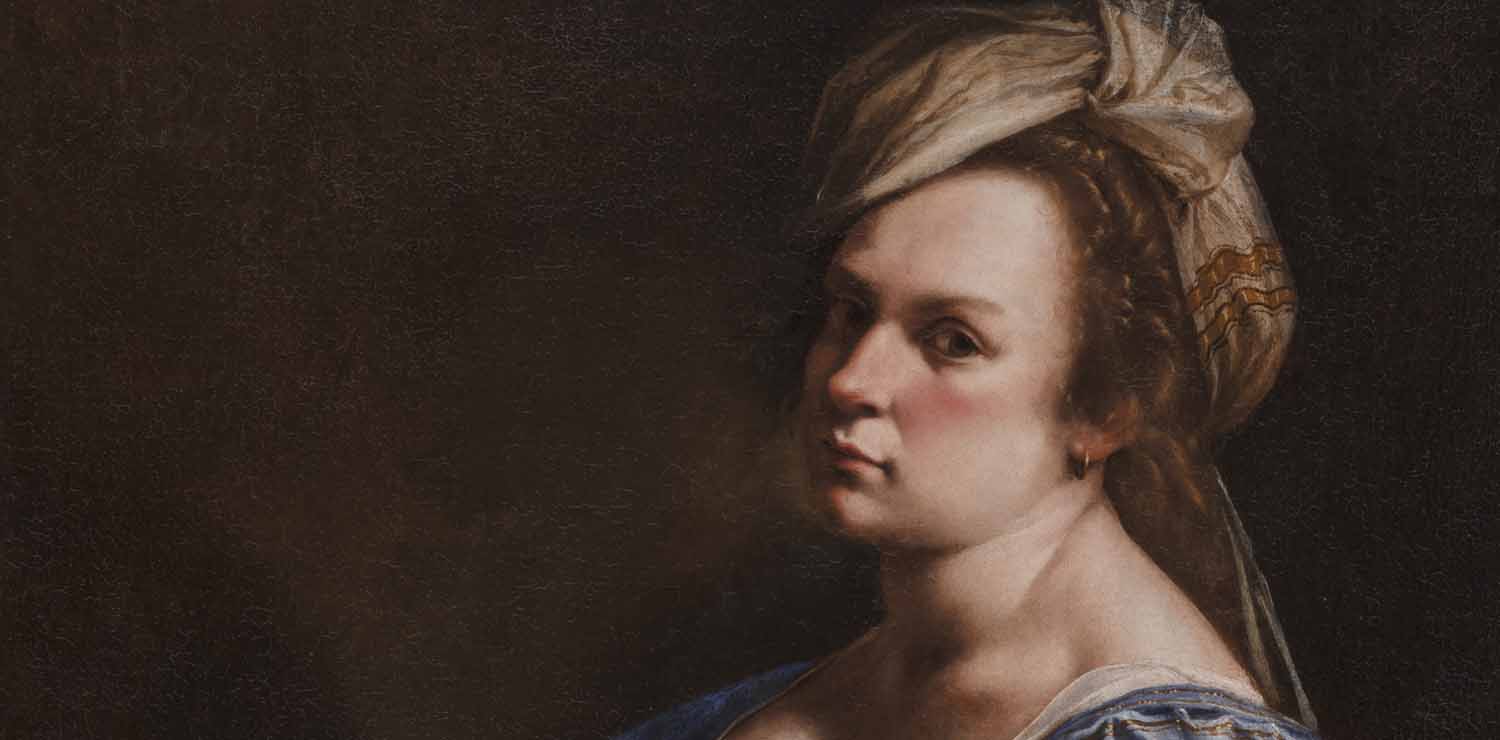


Artemisia Gentileschi in Florence
Seven Decisive Years Amid the Medici, Passions, Independence, and the Rise to Fame
Artemisia Gentileschi’s Florentine period is perhaps the most fascinating chapter of her life. Between 1613 and 1620, Artemisia went from being a young painter scarred by the scandal of a Roman trial to becoming an artist recognized by the Medici court, admitted to the Academy of Arts and Design, and a leading figure in the city’s cultural life. But Florence was also the setting for a complex personal story: an unhappy marriage, motherhood, the loss of her children, financial difficulties, and an intense clandestine love affair, documented by letters discovered only recently.
Her Arrival in Florence: A New Identity
When Artemisia arrived in Florence, between late 1612 and early 1613, she was just nineteen years old. She was married to Pierantonio Stiattesi, a modest Florentine painter, and brought with her the reputation of extraordinary talent and the burden of the trial against Agostino Tassi, her father’s collaborator. In Rome, she had been, above all, the daughter of Orazio Gentileschi. In Florence, she could finally begin to forge an independent identity. During these years, she also used the surname Lomi, belonging to the Tuscan branch of her father’s family. This is an interesting detail, as it allowed her to draw upon an artistic tradition already well-established in Tuscany. The city was ruled by Cosimo II de’ Medici and offered a particularly fertile environment: artists, scientists, writers, and musicians gravitated toward the court and the great patrician families. Artemisia managed to enter precisely this world.
Her Relationship with Cosimo II de’ Medici
Grand Duke Cosimo II de’ Medici became one of her most important patrons. Artemisia soon realized that, to make a name for herself, it wasn’t enough to simply paint well: she needed to navigate a network of relationships, cultivate the trust of collectors, and secure prestigious commissions. For the court, she created paintings with mythological and religious subjects, including works dedicated to biblical heroines. Her style combined Caravaggesque naturalism with the rich colors and refined textures of fabrics particularly prized by Florentine patrons. Her relationship with the Medici family provided her with crucial social legitimacy, though it did not eliminate her financial difficulties.
Michelangelo Buonarroti the Younger and the Censored Painting
A key figure in her Florentine life was Michelangelo Buonarroti the Younger, great-grandson of the great Michelangelo. A man of letters, an intellectual, and a leading figure in the city’s cultural life, Michelangelo the Younger was setting up a gallery in his family’s home on Via Ghibellina dedicated to the glory of his famous ancestor. He invited Artemisia to participate in the decoration.Thus, around 1615–1616, the *Allegory of Inclination* was created: a nude female figure suspended among the clouds, holding a compass and guided by a star. It represents a natural predisposition toward talent. Artemisia received an exceptionally generous fee, higher than that paid to the other artists involved in the decoration.Her relationship with the patron went beyond the strictly professional: documents attest to the familiarity between the two, as well as to the financial loans Michelangelo granted her. There is also a surprising detail. Around 1680, a descendant of the Buonarroti family had the figure’s nudity covered with drapery painted by Baldassarre Franceschini, known as il Volterrano. This was a genuine moralizing alteration that changed the painting’s original appearance. Investigations conducted during the recent restoration made it possible to study the figure hidden beneath these additions.
The Academy and Her Friendship with Galileo
On July 19, 1616, Artemisia became the first woman admitted to the Accademia delle Arti del Disegno in Florence. This was not merely an honorary recognition. The Academy was one of the city’s most important artistic institutions, linked to the tradition of Michelangelo and the prestige of the Medici family. For Artemisia, it meant being recognized as a professional in a field that had until then been reserved for men. During those same years, she met Galileo Galilei, who was connected to the Medici court and the academic circles. Their intellectual relationship did not end during her stay in Florence: in the years that followed, Artemisia would continue to regard him as an important intellectual counterpart. It is fascinating to imagine this young Roman painter coming into contact with some of the leading figures of European culture, moving effortlessly from discussions about painting to the new frontiers of science.
The Secret Love for Francesco Maria Maringhi
This is one of the most interesting—and least known—aspects of her biography. Around 1618, Artemisia began a romantic relationship with Francesco Maria Maringhi, a young Florentine connected to the powerful Frescobaldi family.This is not merely a romantic hypothesis concocted by biographers.In 2011, several letters written by Artemisia and her husband Pierantonio to Maringhi were discovered in the Frescobaldi archive. The correspondence reveals a passionate, jealous, and ironic woman, capable of openly expressing her feelings. In one letter, she addresses Maringhi, affectionately calling him “my dearest heart.” The relationship is all the more surprising because Pierantonio was also in contact with Maringhi, to whom he entrusted certain practical and financial matters. The documents thus suggest a romantic and family situation far more complex than previously imagined. Maringhi also helped her find a home in the area around Piazza Frescobaldi, in the Oltrarno district. Another significant detail: it was precisely during her years in Florence that Artemisia learned to read and write with greater independence. Her letters, full of phonetic spellings and grammatical irregularities, reveal an extraordinarily lively personality.Motherhood and the Farewell to FlorenceHer years in Florence were also marked by motherhood and painful family losses.Artemisia gave birth to several children, including Cristofano, Prudenzia, and Lisabella. The latter died at a very young age in 1619; Cristofano died in 1620, after the family’s return to Rome. Meanwhile, debts were piling up. Despite her artistic success, Artemisia struggled to manage the costs of living and running her workshop. In January 1620, problems also arose regarding the supply of expensive pigments intended for a grand ducal commission. In February of that same year, she wrote to Cosimo II to ask for permission to leave the city. Shortly thereafter, she departed for Rome, leaving behind her possessions, unresolved financial matters, and some unfinished work. She would never return to Florence permanently. Yet it was precisely these seven years that transformed her into an independent artist, capable of dealing with Europe’s leading patrons.
Judith Beheading Holofernes
It was during the final years of her stay in Florence, around 1620, that Artemisia Gentileschi created one of her most famous and powerful works, Judith Beheading Holofernes, now housed in the Uffizi Galleries. The painting, commissioned by Grand Duke Cosimo II de’ Medici, represents the culmination of the artistic maturity she achieved during her seven years in Florence, although it was likely completed in Rome, where the painter returned in 1620.drag embedded assetpublishedJudith Beheading Holofernes - Artemisia Gentileschi - FlorenceArtemisia had already tackled the same subject around 1612–1613, in the version now housed at the Capodimonte Museum in Naples. In the Uffizi painting, however, the scene takes on even greater dramatic force: Judith, aided by her maidservant Abra, plunges her sword into the neck of the Assyrian general Holofernes. The two women act in unison, with a determination and physical strength unusual in the painting of that era. The intense light, the color contrasts, and the realism of the depiction reveal Caravaggio’s influence, but also the extraordinary originality of Artemisia’s artistic language.
The work has often been interpreted as a sort of personal revenge by the artist for the violence she suffered at the hands of Agostino Tassi, as if Judith were a symbolic self-portrait of the painter and Holofernes represented her attacker. This is, however, a suggestive interpretation, not supported by evidence. More certainly, the painting attests to Artemisia’s ability to transform biblical heroines into strong, self-aware, and deeply human protagonists.The history of the painting is also intertwined with the events of the Medici court. The raw nature of the depiction met with some resistance, and Artemisia encountered difficulties in obtaining payment. As late as 1635, by then long gone from Florence, she turned to her friend Galileo Galilei to intercede on her behalf. This episode speaks not only to the painter’s determined character but also to the strength of the bonds she forged during her years in Florence—years that were decisive for her artistic and personal success. It is worth noting that Artemisia had already painted the same subject around 1612–1613, in the version now housed at the Capodimonte Museum in Naples. Thus, by the time she arrived in Florence, she had already tackled the story of Judith and Holofernes. The Uffizi version, however, represents the culmination of her artistic maturation during her Florentine period.
The figure of Judith held particular political significance in Renaissance Florence. Donatello’s bronze group *Judith and Holofernes*, now in the Palazzo Vecchio, had become a symbol of republican freedom and the ability to defeat tyranny.Three figures appear in the famous painting housed in the Uffizi: two women and one man. The women are Judith and her maid, traditionally named Abra. Judith—the woman on the right, dressed in yellow—is the biblical heroine, a young Jewish widow who saves her city from enemy siege. With one hand she wields the sword and with the other she holds Holofernes by the hair. She is the one who carries out the beheading. Abra—the maid on the left, dressed in red—is Judith’s servant and accomplice. In the scene, she holds Holofernes down, helping her mistress kill him. Artemisia assigns her a physically active and decisive role, rather than limiting her to a secondary presence.Holofernes is the commander of the Assyrian army threatening the city of Bethulia. Judith infiltrates his camp, attends a banquet, and waits until he is vulnerable to kill him. Artemisia’s extraordinary innovation lies precisely in the relationship between the two women: Judith and Abra act together, in a coordinated effort. There is not one heroic woman and one passive servant, but two figures who are protagonists of the action. Does Judith represent Artemisia? And is Holofernes Agostino Tassi, who abused Artemisia in Rome?This is one of the most hotly debated questions among art historians. An autobiographical interpretation has often been proposed: Artemisia is said to have depicted herself as Judith and her rapist, Agostino Tassi, as Holofernes. This interpretation stems from the connection between the violence she suffered, her trial, and the ferocity of the scene. However, there is no documentary evidence that definitively identifies Judith with Artemisia or Holofernes with Tassi. We do know, however, that Artemisia did indeed use her own face in several paintings, especially during her stay in Florence, as in the self-portraits depicting her as Saint Catherine of Alexandria or as a lute player.Why is Judith so important specifically in Florence? There is a very interesting historical connection. The figure of Judith held particular political significance in Renaissance Florence. Donatello’s bronze group , now in the Palazzo Vecchio, had become a symbol of republican freedom and the ability to defeat tyranny. Cristofano Allori, a contemporary of Artemisia, had also painted a famous Judith with the Head of Holofernes, now in the Palazzo Pitti.
A legend circulated about this painting claiming that Allori had depicted his mistress Mazzafirra as Judith and himself as the head of Holofernes. Artemisia thus fits into a deeply rooted figurative tradition in Florence. But she profoundly renews its language: compared to the more elegant and idealized representations, she places physical effort, female collaboration, and psychological intensity at the center.
Through April 4, the Museo degli Innocenti in Florence is hosting an exhibition dedicated to Artemisia’s Florentine period, featuring her artistic journey, cultural connections, and comparisons with other leading figures in 17th-century painting.