









Discovering Beato Angelico in Florence: a guide to his must-see works
The Tuscan city has the highest concentration of works by the great artist
Giorgio Vasari, in his biography dedicated to Friar Giovanni da Fiesole, describes him as follows: “He was an excellent painter and miniaturist, as well as an outstanding religious figure.” These few words conceal two different worlds, but in the Tuscan friar they coexist in perfect harmony.
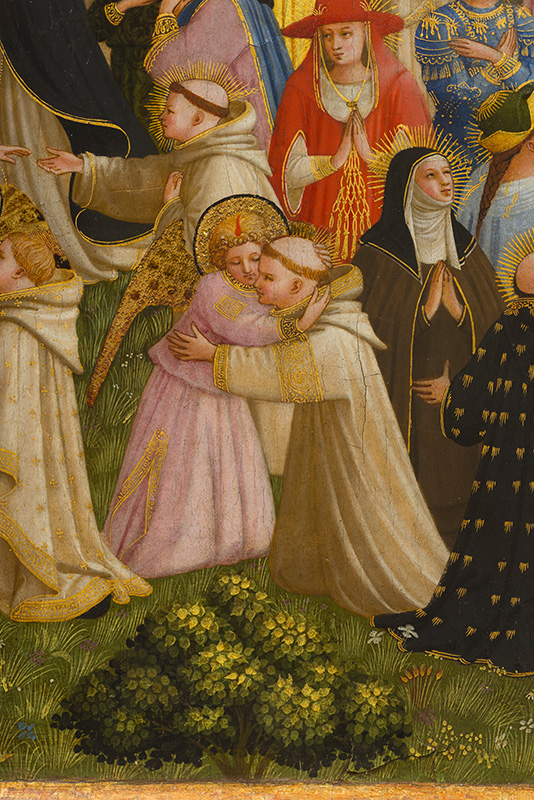 Beato Angelico, Giudizio universale (Photo credits: Su concessione del Ministero della Cultura - Direzione regionale Musei nazionali Toscana - Museo di San Marco)
Biography of Beato Angelico
Guido di Pietro, later known as Giovanni da Fiesole and finally as Beato Angelico, was a Dominican friar with a great talent for painting, who lived between the fourteenth and fifteenth centuries. He was born in Vicchio di Mugello, near Florence, between 1395 and 1400, according to sources. Very little is known about his family of origin; all that is certain is that his father's name was Pietro and that his younger brother, named Benedetto, had also chosen to become a friar. Guido di Pietro took his vows in around 1418 in the convent of San Domenico di Fiesole, taking the name Fra Giovanni. He joined the Observant Dominicans, a minority branch of the Dominican order that observed the rule originally established by St. Dominic, which consisted of absolute poverty and asceticism.
Angelico's artistic education began in the Mugello area, before moving to Florence, where he studied under Lorenzo Monaco and Gherardo Starnina, from whom he learned the use of bright, unnatural colors and the use of strong light to cancel out shadows, respectively.
 Museo di San Marco (ph. Pasquale Paradiso)
With his long experience in San Marco, Beato Angelico's fame also reached Rome, where he worked for Popes Eugene IV and Nicholas V and where, influenced by the solemn ceremonies of the Vatican court, he adopted an elegant style and a celebratory tone, also determined by the classical tradition of the city.
He died in Rome in 1455 and was beatified in 1984 by Pope John Paul II for his religious commitment and dedication to the creation of sacred works of art. However, the use of the term Beato (Blessed) alongside the name Angelico, by which he was known, dates back to the years after his death.
Many legends have arisen around the figure of the friar painter. It is said that he never painted without first praying and never corrected his works, because he was convinced that every brushstroke had a divine origin. Throughout his life, he painted sacred subjects: Annunciations, scenes from the Passion, Madonnas enthroned, and saints. Yet he introduced a touch of realism into these solemn compositions, with figures that appear concrete and solid, reminiscent of the style of the great artist Masaccio. It must be remembered that Beato Angelico lived on the border between two eras.
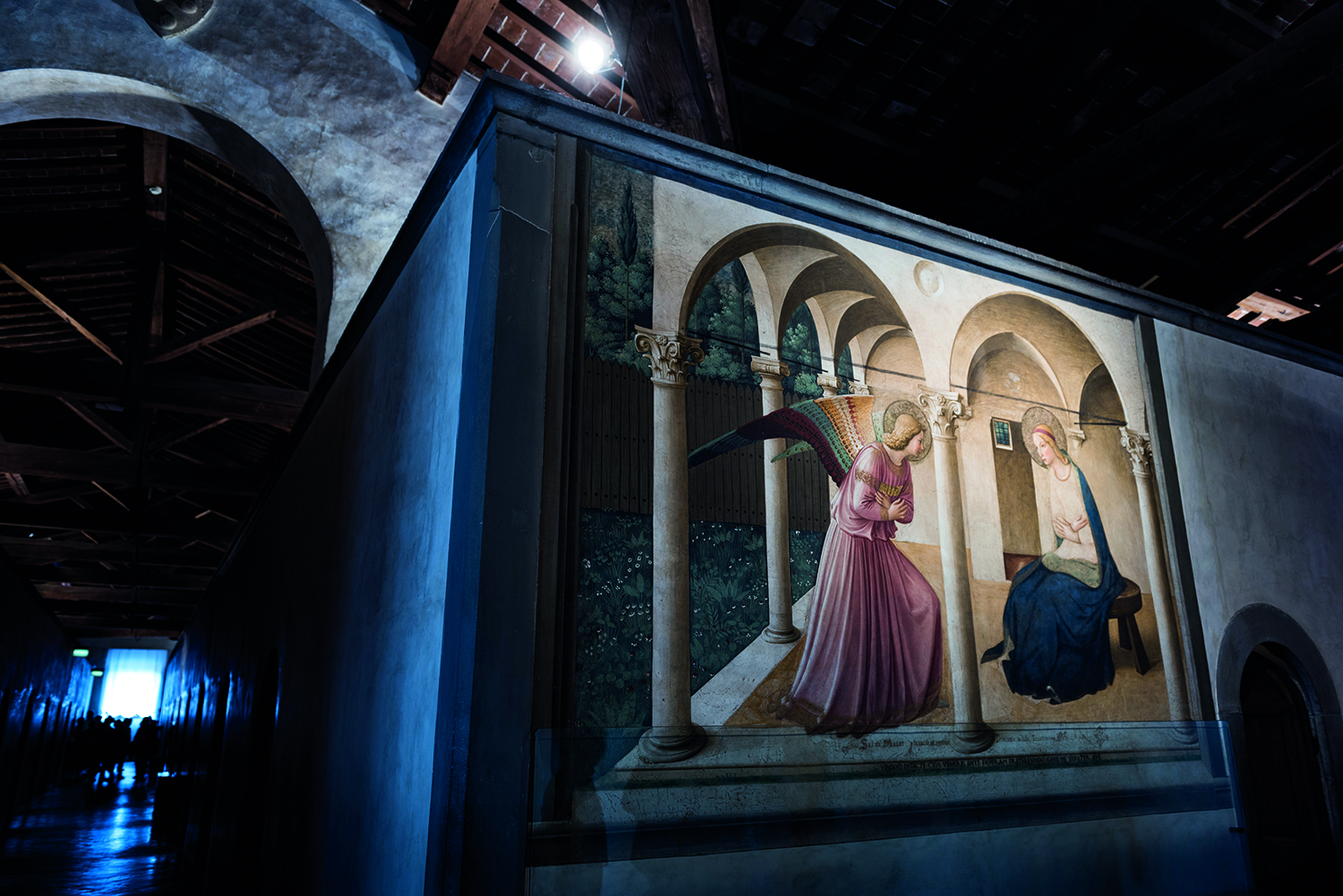 angelico san marco
Convent of San Marco
It was the place where Beato Angelico made the most of his art. The relationship between the Florentine banker Cosimo de Medici and the friar Giovanni, later Beato Angelico, is clearly visible inside the convent: after assigning the convent to the Dominicans, Cosimo sought to bring it back to life with a commission of 40,000 gold florins, entrusted to the architect Michelozzo and the fresco work to the artist friar Giovanni.
From the cloister to the Spizio hall, where the so-called Last Judgment or Tabernacle of the Linaioli is kept, to every cell of the Dominican friars, it is possible to admire the works of Beato Angelico.
Beato Angelico adapts his style according to the audience for whom he is painting. Convinced that faith can save mankind, he depicts the beauty of Creation with a gentle light to inspire wonder in the faithful. But when he paints the frescoes in the monks' cells in the convent of San Marco in Florence, his tone becomes severe, details are reduced to the essentials or transformed into symbols, and the colors become dark. The frescoes depict episodes from the Passion of Christ and, with their drama, invite meditation and repentance. Angelico paints the cross, the nails, the spear, the tomb, and the risen Christ, and includes a friar in prayer in each scene as a witness to an event that is always relevant.
Fra Angelico did not limit his talent to painting, but also contributed to the decoration of manuscripts and liturgical books. His most famous work in this field is the decoration of the antiphonaries of the convent of San Marco.
The historical period
Beato Angelico lived at the turn of two important centuries, the 14th and 15th centuries: in the former, the typical tradition of the Middle Ages was still alive and pervasive, greatly emphasizing golden backgrounds and the representation of very precious fabrics. In the 15th century, however, the typical culture of the Renaissance took hold, and this meant that realism and perspective triumphed in painting.
In Beato Angelico's works, the coexistence of both styles is clearly evident. particularly in his altar paintings, where we can see the typically late Gothic characteristics with which Angelico represented saints or the Virgin Mary. In contrast, the episodes depicted near the base, representing the lives of the saints, are mostly characterized by perspective views and characters dressed in the fashion of the time, reminiscent of Florence at that time. Beato Angelico also adopted a different style depending on the client commissioning the work: he preferred a rich style for the faithful, a sober style for his fellow monks, and a solemn style for the Pope and the Roman Curia.
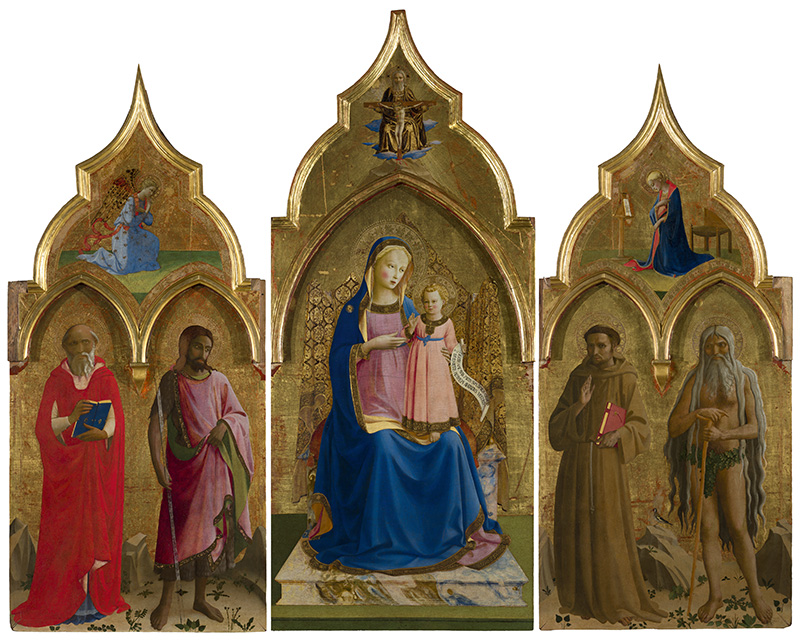 Pala Francescana - Museo di San Marco
 This can be clearly seen in altar paintings (altarpieces), which consist of a large panel, usually depicting the main subject, resting on a base (predella). The predella is a long panel divided into many smaller panels, on which stories are depicted. While the main figures, the saints and the Virgin Mary, appear solemn and monumental, the scenes painted on the base describe episodes from the lives of the saints with a lively narrative: the settings are reminiscent of glimpses of Florence at the time, with buildings in perspective and characters dressed in fashionable clothing. The light becomes real, highlighting objects and figures, enlivening the bright colors, giving unity to the scene, and seeming to create concrete shadows.
The perspective of Beato Angelico
Angelico possessed an accurate understanding of perspective, although his application of it differed from that of some of his contemporaries. His perspective served more to organize the elements of the composition in an orderly fashion than to create complex illusionistic visual effects. His preference for harmonious perspective reinforced his view of art as an instrument of order and beauty.
A distinctive feature of his style was his meticulous attention to detail. The precise rendering of the folds of clothing and the small ornaments in the backgrounds highlight his dedication to artistic perfection. This approach reflected his deep respect for the sacred and his desire to create sacred art of the highest quality.
Major works by Beato Angelico
Annunciation
Fra Angelico tackled the theme of the Annunciation, depicting the encounter between the Archangel Gabriel and the Virgin Mary, in several works throughout his career. This biblical subject was a recurring theme in the artist's work and gave rise to fascinating interpretations, each with its own unique touch. One of Fra Angelico's most famous representations of the Annunciation is preserved in the Museum of San Marco in Florence. This painting, created between 1438 and 1446, is located in a cell of the Dominican convent of San Marco, where the friars could contemplate the work in the tranquility of their monastic environment. In the painting, the Archangel Gabriel, depicted as an ethereal and luminous angel, approaches the Virgin Mary, kneeling in prayer, with respect and grace. Mary, surprised and devout, is portrayed within a sacred architecture, with the surrounding environment illuminated by a divine light that gives the entire scene a mystical atmosphere.
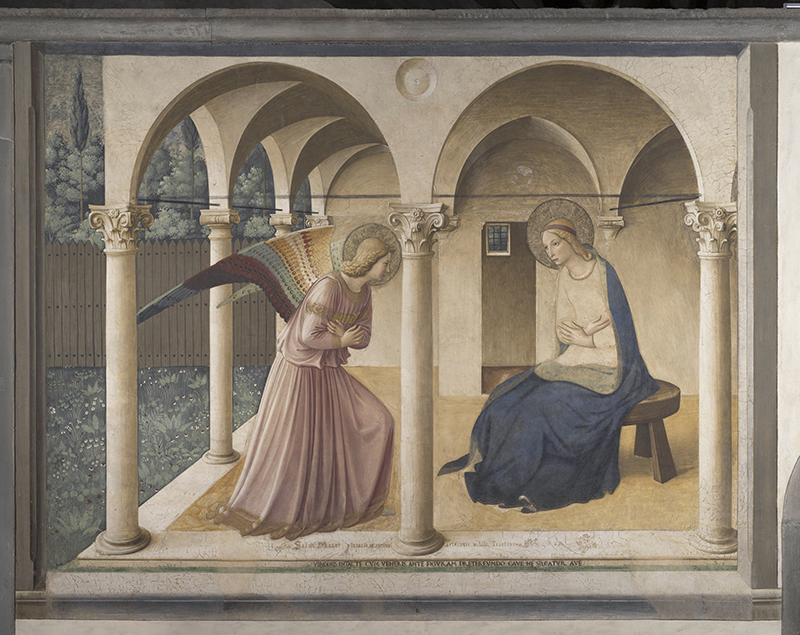 Annunciazione - San Marco
 The Adoration of the Magi
A recurring theme in Christian art, it has inspired numerous artists over the centuries. A notable example is Fra Angelico's “The Adoration of the Magi,” housed in the Museum of San Marco in Florence. This painting, created between 1440 and 1460, depicts the moment when the Three Wise Men, guided by the star, bring their gifts to the Baby Jesus. In the painting, the Magi, depicted in richly decorated robes and crowns, kneel in homage before the Child. Their gesture of adoration is imbued with a profound spirituality, highlighted by the expression of devotion on their faces. Fra Angelico made each figure unique, with distinctive details that emphasize the diversity among the Magi.
The Flagellation of Christ
Fra Angelico addressed this theme in more than one of his works, creating representations of this crucial moment in the Passion of Christ. One of these works, exemplary for its spiritual depth and artistic refinement, is preserved in the Museum of San Marco in Florence. In Fra Angelico's painting of the “Flagellation of Christ,” created between 1440 and 1441, the artist offers an intense and moving vision of the moment when Jesus is flogged during his Passion. The scene is set in an architectural context, and divine light permeates the composition, illuminating the body of Christ and accentuating the intensity of his suffering. Jesus is depicted tied to a column while his executioners whip him. Despite his physical suffering, his figure exudes a sense of dignity and devotion. Fra Angelico's choice to represent Christ with grace and composure emphasizes this aspect.
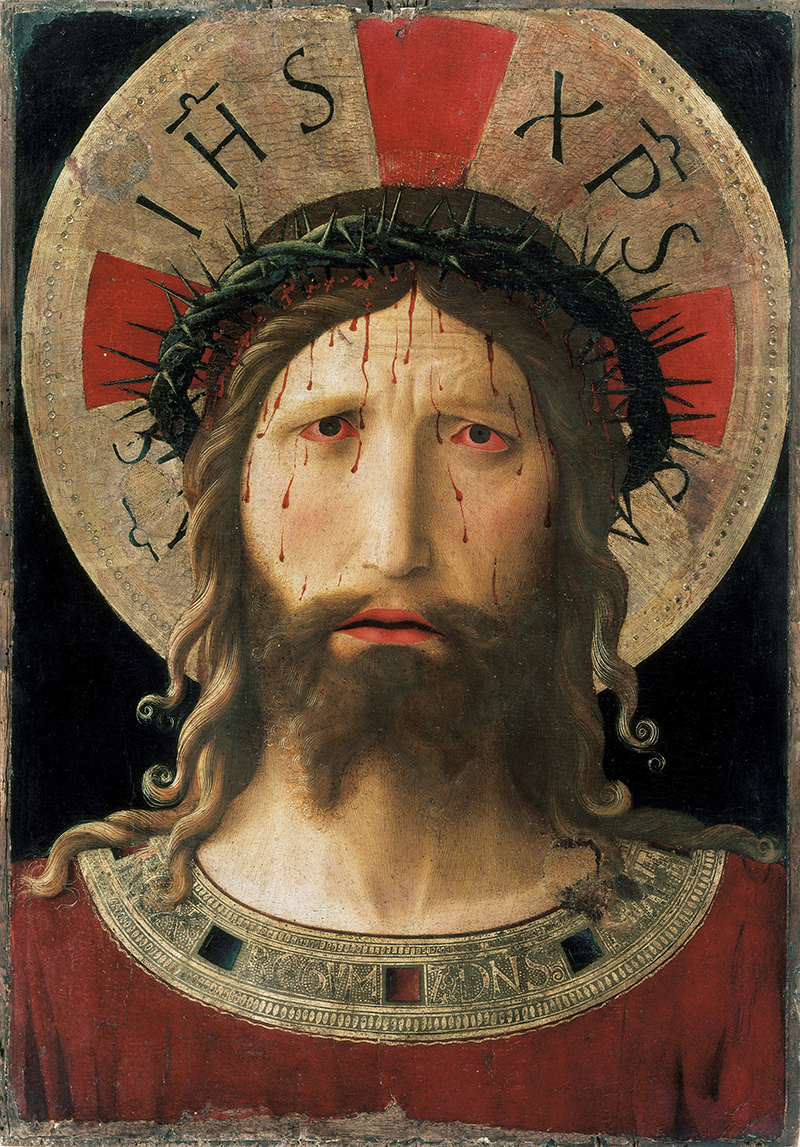 La Flagellazione Di Cristo