

Edward Hopper in Pisa
From October 14 to March 7, 2027, Palazzo Blu is hosting an exhibition featuring over 150 works that tell the story of the artist who transformed solitude and everyday life into timeless images
Lighted windows, deserted streets, figures lost in their own thoughts: in the works of Edward Hopper, American modernity is revealed through suspended atmospheres, in which every everyday scene holds a mystery. It is precisely this perspective—capable of transforming reality into a reflection on solitude and the human experience—that takes center stage in the exhibition Edward Hopper: New York and Beyond, on view at Palazzo Blu in Pisa from October 14 to March 7, 2027.
The exhibition brings together over 150 works, including oil paintings, drawings, watercolors, and etchings, accompanied by archival materials from the Whitney Museum of American Art in New York, which houses the world’s most significant collection dedicated to the artist. Curated by Barbara Haskell, together with Caroline Webb, the exhibition is organized by the Whitney Museum in collaboration with Fondazione Palazzo Blu and MondoMostre, with the support of Fondazione Pisa.
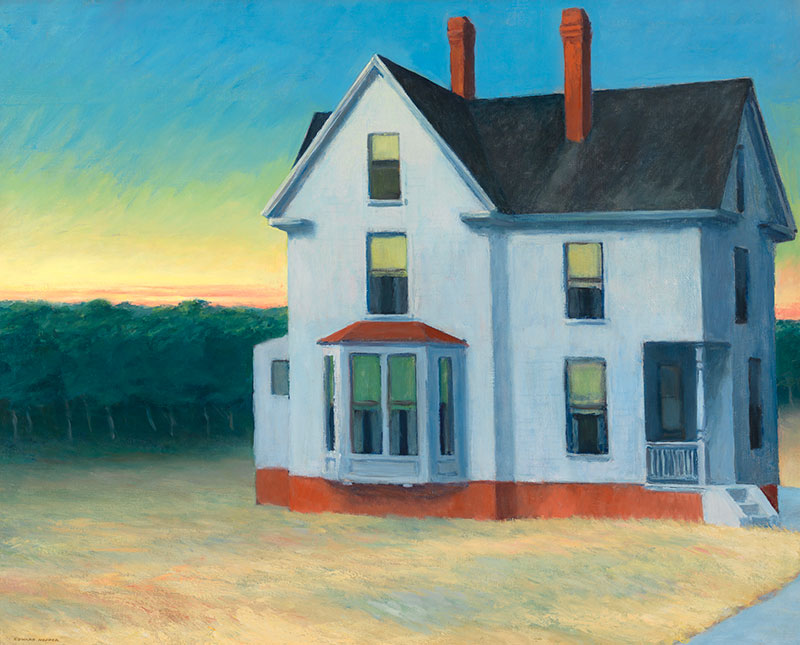 Edward Hopper, Cape Cod Sunset / Tramonto a Cape (© Heirs of Josephine N. Hopper/SIAE)
From Paris to New York, all the way to the coast of New England
The exhibition takes visitors on a journey through the places that shaped the life and artistic exploration of Hopper, born in 1882 in Nyack, New York State. Three locations are central to his artistic vision: Paris, where the artist lived from 1906 to 1910, engaging with European painting and Impressionism; New York, which became the center of his artistic practice; and New England, with its coastlines, lighthouses, and isolated architecture.
It is above all the American metropolis that provided Hopper with the most emblematic subjects of his painting. Far from the city’s monumental images, the artist observed storefronts, apartments, offices, theaters, and streets, transforming ordinary spaces into scenes charged with emotional tension. His figures, often alone or close together yet unable to communicate, seem to inhabit a suspended moment in time. Light, shadows, and the rigorous construction of geometries contribute to creating enigmatic images that still speak to our present day.
In his New England landscapes, however, Hopper explores the relationship between architecture and nature. From Gloucester—where, in 1923, he met his future wife, Josephine Nivison, known as Jo—to Maine and Cape Cod, houses, lighthouses, and coastal expanses become the focal points of a minimalist style of painting in which light plays a central role.
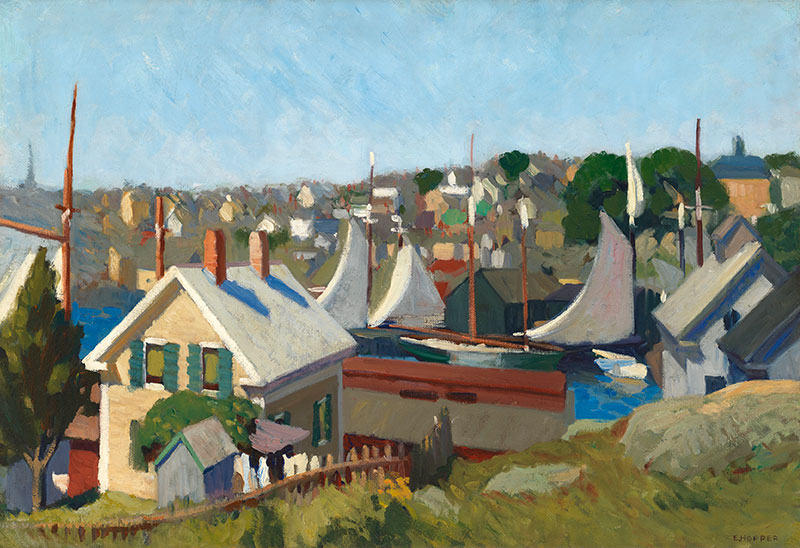 Edward Hopper, Gloucester Harbor / Porto di Gloucester (© Heirs of Josephine N. Hopper/SIAE)
Edward and Jo Hopper: A Story of Art and Life
An important section of the exhibition is dedicated to the relationship between Edward and Jo Hopper, who were married in 1924. As both an artist and his life partner, Jo also served as the model for nearly all of her husband’s paintings, in addition to playing a fundamental role in documenting and preserving his work. Her notebooks, filled with notes on paintings, exhibitions, and collectors, remain a valuable resource today for reconstructing the artist’s creative journey.
Alongside Hopper’s works, visitors will discover pieces by other leading figures in early 20th-century American art, including Robert Henri, George Bellows, John Sloan, and Charles Sheeler. This comparison allows us to situate his artistic exploration within the context of the artistic and social transformations in the United States, highlighting the originality of a style that captured modernity through the apparent stillness of objects.
Organized into five sections—from his early days in Paris, to New York and New England, and finally his relationship with Jo—the exhibition thus offers a comprehensive overview of Hopper’s career, interweaving paintings, works on paper, and historical documents.
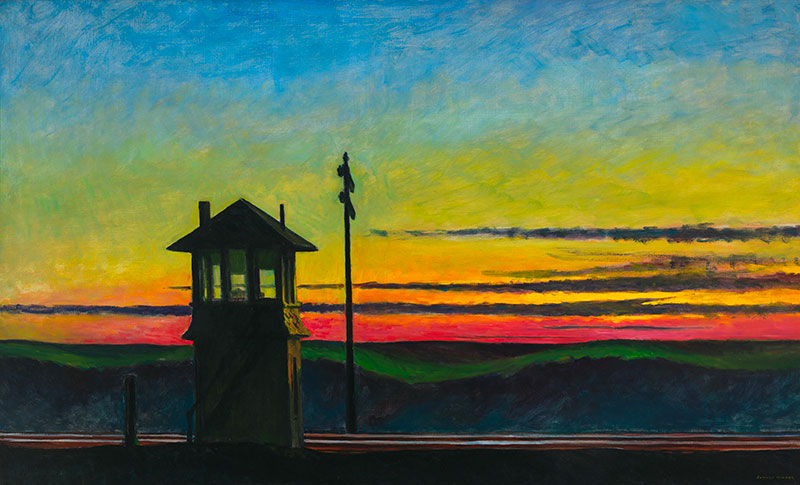 Edward Hopper Railroad Sunset / Tramonto sulla ferrovia (© Heirs of Josephine N. Hopper/SIAE)
An exhibition in dialogue with Pisa
The initiative is accompanied by a program of events that extends the experience beyond the halls of Palazzo Blu. Starting October 21, 2026, the Cinema Arsenale will host the film series Lights and Expectations: The Allure of Hopper in the Cinema of Hitchcock, Argento, Lynch, and Antonioni, dedicated to the artist’s influence on cinematic language. The program also includes in-depth lectures and activities aimed at schools and universities, with a special focus on younger visitors.
With “Edward Hopper: New York and Beyond,” Palazzo Blu renews its dialogue with major international cultural institutions and brings to Pisa an artist whose work continues to challenge the way we inhabit spaces, view others, and perceive time. This is an opportunity to engage with one of the great artists of 20th-century America and, through his images, rediscover the extraordinary narrative power of everyday life.