









Georg Baselitz at the Museo Novecento
Until September 13, Florence is hosting a retrospective featuring 170 works that celebrates over 60 years of Baselitz’s radical and nonconformist art
Sergio Risaliti guides us—for the new issue of Firenze Made in Tuscany Magazine - through Avanti!, the major exhibition dedicated to Georg Baselitz. A journey spanning over sixty years of artistic exploration that, through some 150 works on paper, paintings, and sculptures, captures the indomitable spirit of an artist who has always chosen to forge ahead, even as he turns his gaze on the world upside down. Here are his words.
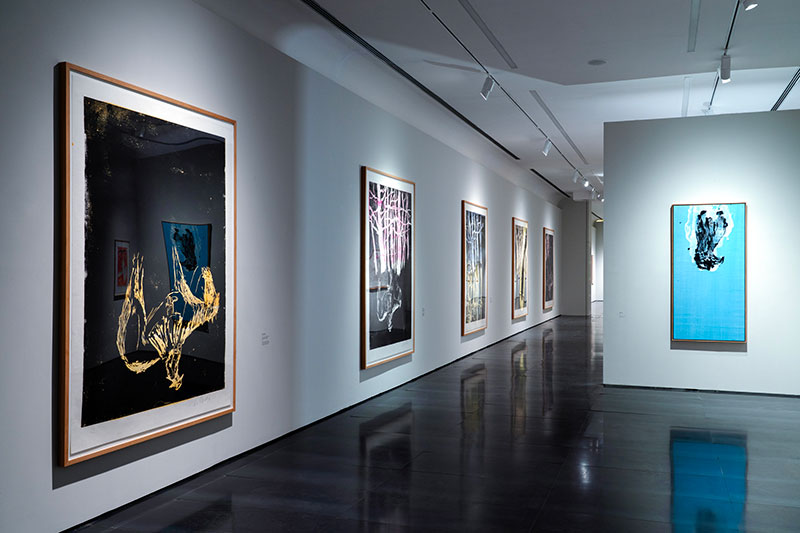 BASELITZ. AVANTI! (2026), Courtesy Museo Novecento and the artist (ph. Elisa Norcini)
Active for over sixty years, George Baselitz has consistently refused to confine his creative energy within a single technique or style. He has pursued a solitary artistic quest, resolutely defending artistic practice as an individual experience, following in the footsteps of other great masters of the past. For this reason, he has always avoided joining groups, movements, or trends. As Ulrich Weisner observed: “Baselitz has found an individual path for himself that cannot be imitated nor can it become a style.” This spring, the Museo Novecento, with the exhibition Avanti!, presents the artist’s entire body of graphic work, unanimously recognized as one of the pinnacles of his artistic practice. The exhibition features approximately 150 works on paper, alongside five paintings and five sculptures, a testament to the profoundly multifaceted nature of his work. The works, created using various printmaking techniques and spread over the museum’s three floors, demonstrate that printmaking is by no means a secondary or marginal activity.
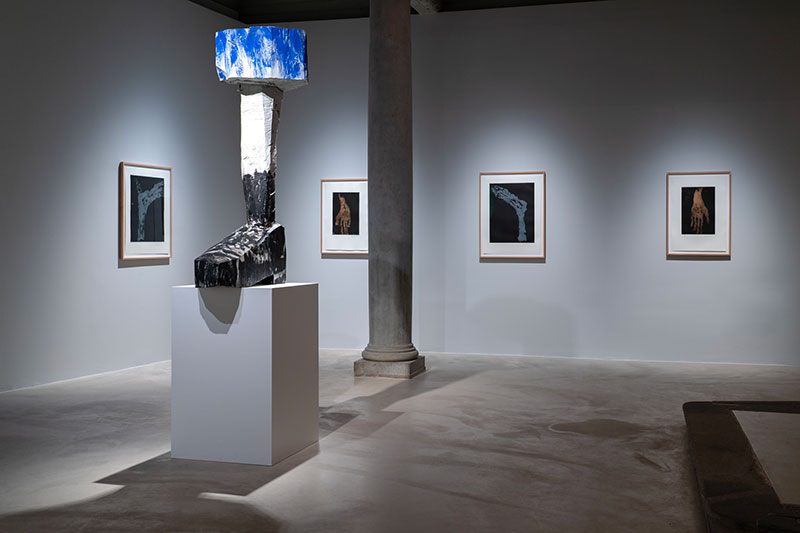 BASELITZ. AVANTI! (2026), Courtesy Museo Novecento and the artist (ph. Elisa Norcini)
As Baselitz himself stated: “I have always created woodcuts when I felt the need to define, in a definitive form, an image – or an idea of an image – that I had developed and that had manifested itself in paintings.” This urge has accompanied him for decades, driving him to devote himself to printmaking with extraordinary and consistently original results. As early as 1964, Baselitz had immersed himself in printmaking, during a period dominated by an ideology of progress that excluded any form of return to the past. Overtly defiant of this trend, the artist embarked on a path that led him to engage once again with art history and the most ancient traditions, both in painting and sculpture, approached with freedom and a nonconformist spirit. It is therefore not surprising that he carves wood as if he were a master carpenter, nor that he chose to create polychrome sculptures in stark contrast to the industrial and serial forms of Judd, Warhol’s Brillo Boxes, or the neo-realism of Arte Povera.
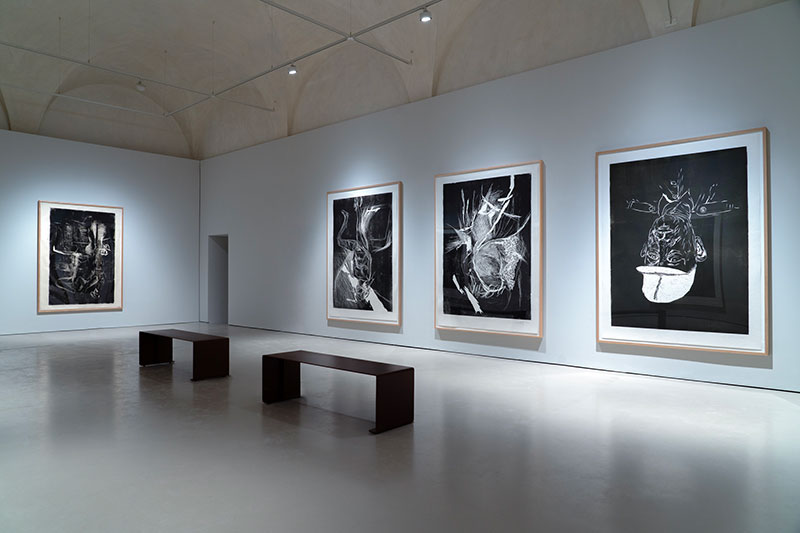 BASELITZ. AVANTI! (2026), Courtesy Museo Novecento and the artist (ph. Elisa Norcini)
Visitors to the exhibition Avanti! thus find themselves before an artist who, while using seemingly anachronistic techniques, is in fact pursuing a radically innovative path, devoid of nostalgia and regression. Such an ability to move forward by drawing on elements of the past is found only in Picasso and a few other artists at this level and with this freedom. Born in 1938 in Germany, Baselitz grew up in the rubble of World War II, witnessing the collapse of European civilization, built and fallen walls, youth uprisings, and the failure of political utopias. From the very beginning, he challenged the rules of traditional representation and moral conventions, adopting extreme positions and developing a restless, provocative, and deeply anti-academic language.
 BASELITZ. AVANTI! (2026), Courtesy Museo Novecento and the artist (ph. Elisa Norcini)
Free to the point of being unpopular, Baselitz fearlessly confronted the crisis in painting, marked by Duchamp’s legacy. By accepting the destruction of figurative language, he attempted to rebuild it from its own ruins, exploring the hidden potential of images and reclaiming ancient and primordial iconographies. He is also famous for inverting subjects, presenting them upside down: a gesture at once symbolic and conceptual, that destabilizes the gaze and forces the viewer to confront an unnatural vision. Turning the image upside down also means questioning time and space, altering our way of perceiving reality. Artists’ sources of inspiration often remain enigmatic. It is possible that Baselitz was struck by images from the past, such as those by Filippino Lippi in the frescoes of the Church of Carmine in Florence, perhaps observed during his stay at Villa Romana in 1965. One of his first inverted figures, Fingermalerei from 1972, bears some resemblance to the image of a crucified upside down Peter as in the Brancacci Chapel. Through these inversions, Baselitz suggests that nothing is final, that creative energy transcends everything – every tragedy, collapse, or fracture – and that one must move forward without ever ceasing to transform and reorganize the visual field, the figurative structure, and the enduring, perpetual principles of art history. In this sense, he has literally turned figurative language upside down, seeking within the very terrain of art the seeds of a possible rebirth after Duchamp and before the return to painting of the 1980s.
There is, in fact, a significant distance between his language and the narrative appropriation of postmodern painters. His works may appear deliberately awkward, childlike, or dissonant; the strokes are nervous, irregular, the colors at times strident. The strength of his work lies precisely in this apparent disharmony: an expressive freedom supported by a solid conceptual vision. After all, learning to draw like a child can take a lifetime. Without Baselitz’s paintings, sculptures, and above all his extraordinary graphic work, it would be difficult to understand what it truly means to ‘move forward’, even when reversing the direction of time.
