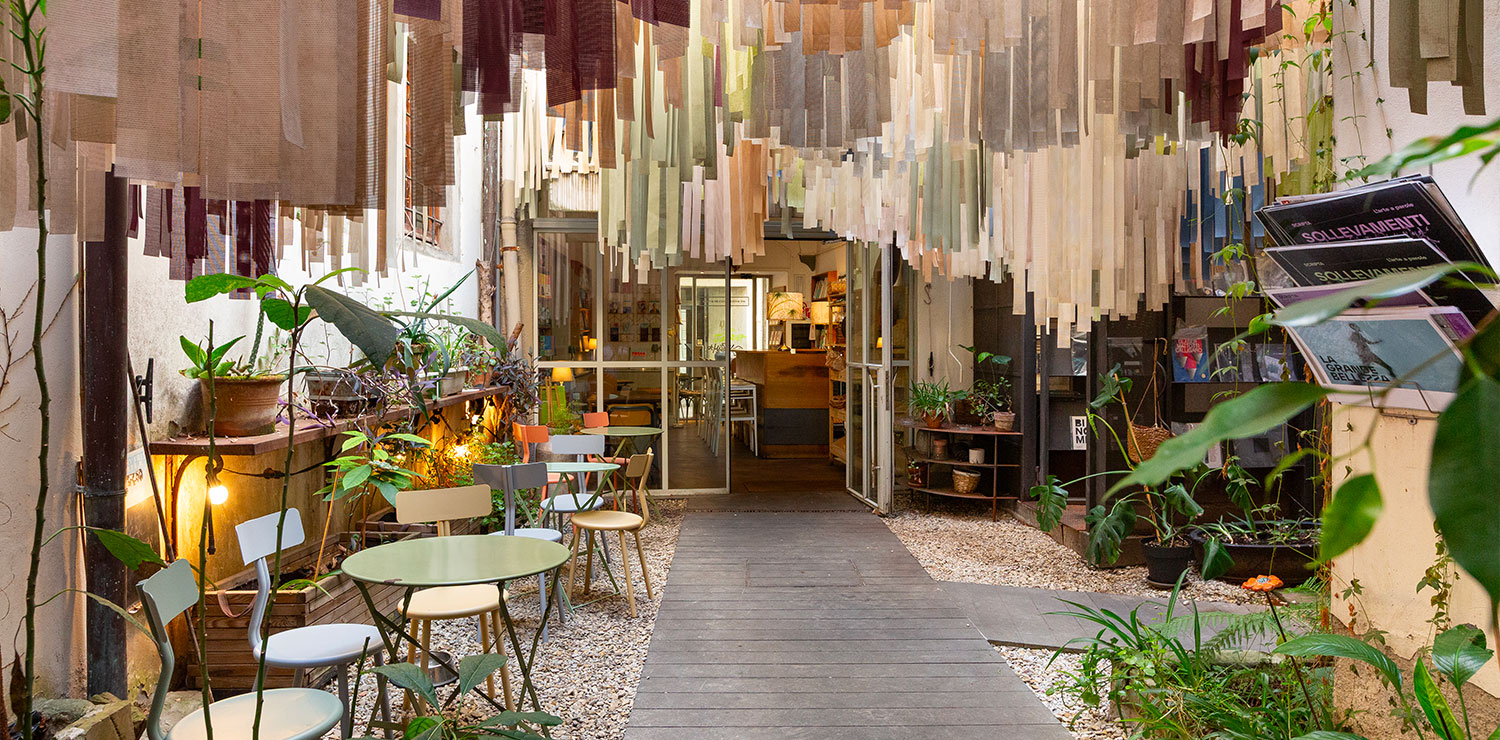

photo Ela Bialkowska, OKNO Studio



The major Mark Rothko exhibition at Palazzo Strozzi
From March 14 to July 26, one of the largest exhibitions in Italy dedicated to the master of American modern art
Yellow on purple, just like another unforgettable and equally restless artist. At Palazzo Strozzi from 14 March to 23 August 2026, Fondazione Palazzo Strozzi presents one of the most important exhibitions in Italy ever devoted to Mark Rothko. Curated by Christopher Rothko and Elena Geuna, Rothko in Florence is a unique project, the largest ever held in Italy, conceived specifically for Palazzo Strozzi and celebrating the special bond between the artist and the city. The building’s architecture and Florence itself are the ideal setting to explore Rothko’s way of translating classical balance and expressive freedom, using colour to create a new perception of space that moves far beyond the two-dimensional surface of the canvas.
The exhibition at Palazzo Strozzi develops chronologically and traces Rothko’s entire artistic career, from the 1930s and 40s – featuring figurative works that dialogue with Expressionism and Surrealism – to the 50s and 60s and his celebrated abstract canvases using huge areas of colour that engage deeply with the viewer thanks to an expressive language steeped in poetry and spirituality. The exhibition features works from prestigious private collections and major international museums.
 Mark Rothko, No. 3/No. 13, 1949
As with Van Gogh – mentioned above for his use of colour – this too is a story of a genial and cultured man who created an utterly original visual language, albeit apparently simple. Mark Rothko (1903-1970) was a Jewish immigrant who in 1913, aged just ten, left his homeland of Russia and moved to the United States with his entire family, fleeing a new wave of antisemitism. America was the training ground for one of the 20th century’s best known and most recognisable artists, a leading exponent of so-called “colour field painting”, characterised by blocks of colour that expanded to cover the whole canvas. Fifty years have passed since the artist’s death by suicide in his New York studio, but his paintings continue to move and inspire reflection among today’s audiences. And this was precisely Rothko’s intention: “I’m only interested in expressing fundamental human emotions”. Indeed, with his use of colour, the artist sought to create “a complete experience between painting and viewer”, in a spiritual interior dimension. His now iconic works take the form of blocks of vibrant colours: red, yellow, black or green, in which the human figure is completely absent, replaced by tonal fields that are an intimate expression of the human condition.
 Rothko a Firenze, Palazzo Strozzi (photo Ela Bialkowska, OKNO Studio)
Painting, and observation of it, thus become a form of prayer. In an interview, Rothko commented, “The fact that many people are deeply disturbed and weep when they find themselves in front of my paintings shows that I’m able to give expression to fundamental human emotions. People who weep when faced with my paintings are affected by the same religious experience I feel when I create them”. To him, tragedy and ecstasy are the essential conditions of life, expressions of the universal human drama that he himself experienced as a very young child.
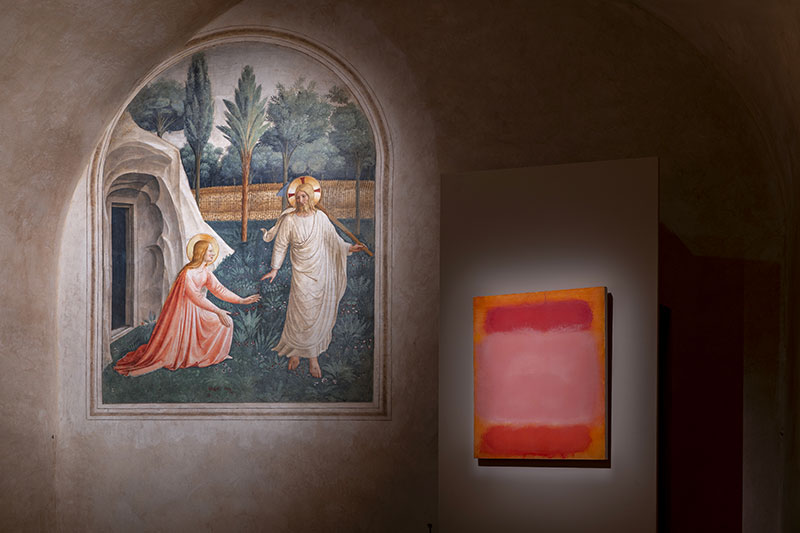 Rothko a Firenze, Museo di San Marco (photo Ela Bialkowska, OKNO Studio)
The artist’s first encounter with Florence came in 1950 during a trip to Italy with his wife Mell. Rothko was particularly fascinated by Fra Angelico’s paintings in the Museo di San Marco and the architecture of the Vestibule of the Biblioteca Medicea Laurenziana. This unique space – which he would revisit in 1966 – became the source of inspiration for his Seagram Murals series, painted in the late 1950s. Meanwhile, his more subtly-coloured works hint at the influence of 15th-century Italian art, that of Fra Angelico in particular. Both artists share a desire to evoke a sense of transcendence, a dimension that is both distant and deeply familiar. On the basis of this experience, the exhibition expands from Palazzo Strozzi to the wider city of Florence, encompassing two places that were particularly important to the American artist in two satellite exhibits: the Museo di San Marco, where his works are displayed in dialogue with Fra Angelico’s frescoes, and the Vestibule of the Biblioteca Medicea Laurenziana, designed by Michelangelo.