

Giotto in Florence: his Works, his Life, and the famous bell tower
A tribute to Giotto, the painter who revolutionized medieval art: from the masterpieces at Santa Croce and the Uffizi to the Campanile, the symbol of Florence
Considered one of the fathers of Italian painting and one of the great figures in art history, Giotto di Bondonerevolutionized the figurative language of the Middle Ages, paving the way for the artistic achievements of the Renaissance. Born probably in Vespignano, in the Mugello region, around 1267, tradition holds that he was discovered as a child by Cimabue, who is said to have caught him drawing a sheep on a stone and immediately recognized his extraordinary talent. Giotto thus entered the master’s workshop, where he learned the fundamentals of painting, soon developing a personal style destined to change the way reality was depicted forever.
With Giotto, in fact, painting gradually moved away from the rigidity of Byzantine imagery to embrace a new human dimension. Figures gained volume and solidity, faces expressed emotions, gestures became natural, and settings took on a depth unknown to the previous tradition. His characters seem to truly live out the stories depicted: they suffer, are moved, embrace one another, and look into each other’s eyes. It was a revolution that concerned not only painting technique but also the ability to tell stories through images.Giotto’s extraordinary skill has inspired numerous anecdotes over the centuries, some of which were passed down by Giorgio Vasari in his Lives. One famous anecdote tells of a fly that the young artist allegedly painted on a panel with such realism that Cimabue tried to swat it away with his hand. Equally famous is the story of the “O di Giotto”: when an emissary of Pope Benedict XI asked him for a drawing to demonstrate his skill, the painter is said to have drawn a perfect circle freehand, in a single stroke.
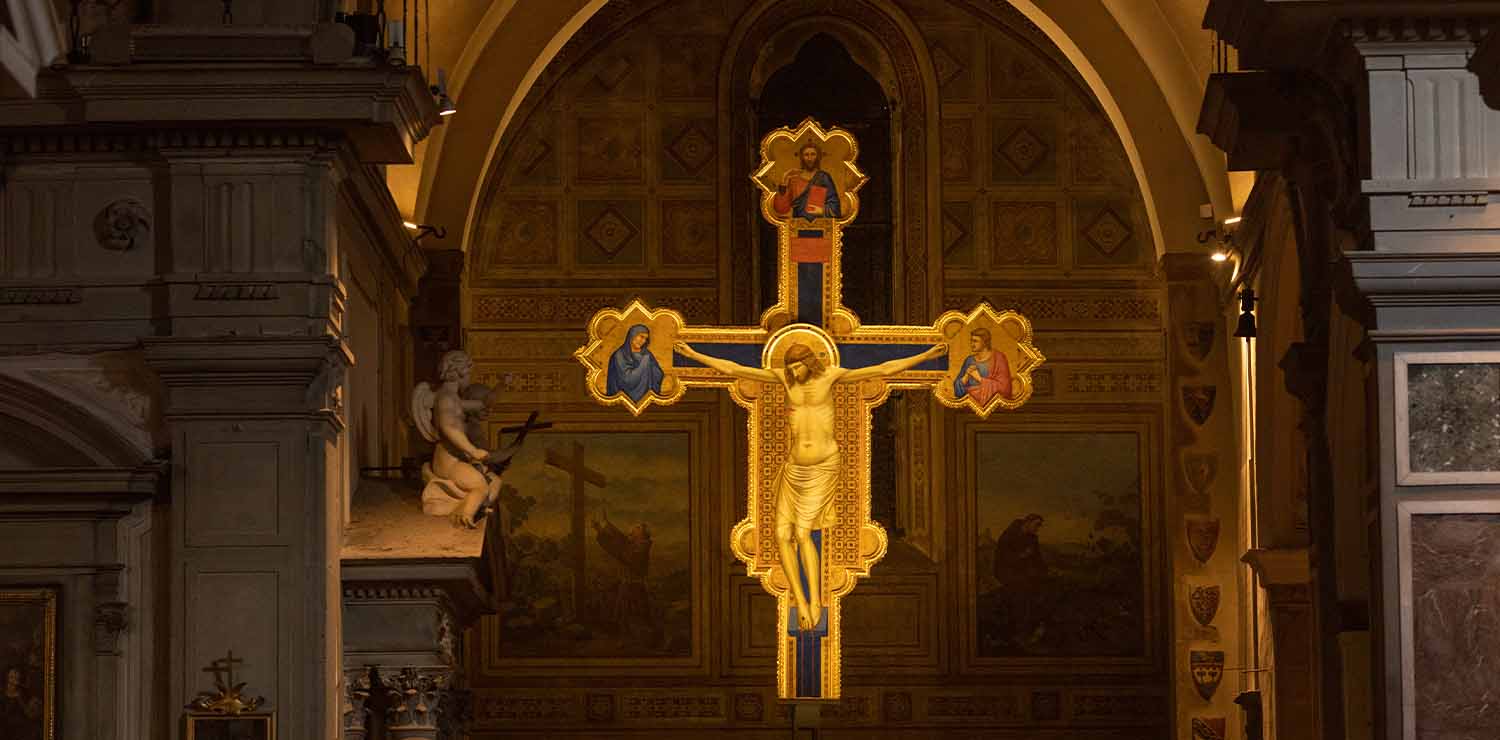
A seemingly simple gesture that became a symbol of his exceptional mastery.Giotto’s talent was also recognized by his contemporaries. Dante Alighieri, in the eleventh canto of Purgatorio, celebrates his fame, noting how he had by then surpassed even that of his master, Cimabue. Boccaccio, too, in the Decameron, extols his ability to reproduce nature with such fidelity that the painted objects appear real.Florence preserves some of the most important examples of his art—works that allow us to trace the evolution of his artistic language and understand the scope of his revolutionary approach to painting. In the Basilica of Santa Maria Novella stands the monumental Crucifix, created around 1290, one of the artist’s first great masterpieces. Christ is no longer depicted as an abstract and solemn figure, but as a man truly suspended on the cross, his body marked by the weight and suffering. His humanity emerges with an expressive power destined to profoundly influence subsequent painting.Another essential stop for exploring Giotto’s work in Florence is the Basilica of Santa Croce, where the artist created the frescoes in the Bardi and Peruzzi chapels, commissioned by two prominent Florentine families of merchants and bankers.
 Santa Croce (ph. Pierpaolo Pagano)
In the Bardi Chapel, he depicts episodes from the life of St. Francis, while in the Peruzzi Chapel he focuses on the stories of St. John the Baptist and St. John the Evangelist. The scenes are constructed like true theatrical narratives, in which architecture, characters, and landscapes combine to create compositions of extraordinary narrative intensity.
Here, Giotto demonstrates a new sensitivity in depicting the emotional states and relationships between the figures, foreshadowing the pursuit of naturalism that would become central to Renaissance art.The Uffizi Galleries, on the other hand, house the splendid Maestà di Ognissanti, painted in the early 14th century for the high altar of the Florentine church of the same name. The Madonna, seated on a monumental throne and surrounded by angels and saints, appears as a solid, three-dimensional figure. The refined use of color, the interplay of light and shadow, and the construction of space attest to the extraordinary modernity of his painting. The work is particularly significant also because, in the halls of the Uffizi, it can be compared with the great “Maestà” works by Cimabue and Duccio di Buoninsegna, offering immediate evidence of the change introduced by Giotto.The artist’s fame soon spread beyond the borders of Florence. He worked in Assisi, where his name is traditionally linked to the frescoes dedicated to St. Francis in the Upper Basilica—whose attribution remains a subject of debate—and, above all, in Padua, where he created one of the greatest masterpieces of Western art: the fresco cycle in the Scrovegni Chapel, featuring the stories of the Virgin and Christ and the magnificent Last Judgment. His ability to construct a believable space and to depict human emotions reaches here heights of exceptional modernity.Giotto’s connection to Florence is also expressed through architecture. In 1334, now at the height of his fame, he was appointed master builder of the Santa Maria del Fiore project and tasked with designing the cathedral’s new bell tower. Thus was born the famous Giotto’s Bell Tower, one of the most recognizable symbols of the Florentine skyline. Clad in white, green, and red marble—in harmony with that of the Cathedral and the Baptistery—the bell tower stands out for the elegance of its proportions and the richness of its decorations. Giotto designed the structure and oversaw the construction of the first level, but he died in 1337 before seeing the work completed. The work was continued by Andrea Pisano and subsequently by Francesco Talenti, who completed the construction in 1359.The bell tower’s sculptural decoration, now preserved in its original form at the Museo dell’Opera del Duomo, constitutes an extraordinary visual narrative of human activities, the arts, the sciences, and medieval knowledge. This iconographic program reflects the cultural ambition of 14th-century Florence, a city of merchants, artists, and intellectuals.Giotto died in Florence on January 8, 1337, leaving a legacy destined to profoundly shape the history of art. His greatness lies not only in having introduced new technical innovations, but above all in having restored to painting the ability to represent life, with all its complexity and emotional intensity. A lesson that would be taken up, more than a century later, by artists such as Masaccio and Michelangelo, and which makes Giotto one of the foremost figures of Florentine and Italian culture.